YES, YOU CAN KNIT.
PATTERNS, HOW TO READ THEM
Knitting patterns.
Some people love them, others hate them. Most knitters end up using them, because - let's face it - it is much easier not having to 'invent the wheel' and instead just use what someone else has already figured out. Besides, there are many absolutely stunning designs out there that you may want to make.
The main reasons people struggle with knitting patterns are that some are badly written, others have been badly translated, but mostly that people struggle with all the abbreviations and technical terms.
So, let's demystify knitting pattern.
Most, if not all, knitting patterns have a number of sections:
- Name of the pattern and designer's name
- General description, sometimes including photo(s)
- List of required materials and tools
- Tension/gauge and sizes (if relevant)
- List of abbreviations
- Instructions
- Diagrams and charts
The pattern and designer names and description speak for themselves.
Let's look at the other sections.
Pattern sections
A pattern should give information on which type and size of knitting needles and which yarn to use. This will usually be the needles and yarn the designer used to knit their creation.
If you wish to make the item exactly as it was intended, it is advised to use the same materials and needles the designer states in the pattern. It still depends on the desired size of the project and how close your tension is to the one in the pattern, so - even if you were to use the exact same yarn - it is unlikely you'll get an exact match. More on that later (under 'tension/gauge' and 'sizes').
Quite often a designer will suggest a particular brand of yarn or a particular material (what the yarn is made of). You can absolutely change that.
All you have to do is search for the suggested yarn and see what type it is. What is the yarn's weight? What is the material?
You can then find a replacement yarn of a similar weight and/or material that suits you better.
And yes, you can change yarn weight and material entirely, but that will require quite a bit of calculating to make sure the pattern will still work for you. That is advanced stuff, so I won't cover that in this article.
Overall it is easier to use a yarn weight that closely matches what the pattern designer advises.
Materials and tools
First of all, tension and gauge are terms that mean the same thing: how many stitches and rows you have within a certain size of square.
Second, tension may not be relevant.
If you are knitting a dish cloth, you won't have to swatch to check your tension. There may be some blankets where you would like to get a certain size, but overall we don't check tension for those either.
Tension becomes important when the item you are making is wearable.
When a designer writes the pattern, they include tension/gauge information to make sure you will know how big a garment will turn out to be.
Example: if they state a gauge of 24 stitches and 23 rows (usually written as 24 x 23) will make a 4" x 4" square (10 x 10 cm), it stands to reason that 100 stitches will give a width of 16".
If your gauge is 20 stitches and 18 rows to a 4" x 4" square, 100 stitches will give you a width of 20".
Now, this is only an example in which I have disregarded the rows. Also, differences are hardly ever that big. But you can see you will end up with an incorrect size.
This is why tension matters.
For small differences in tension you can simply use smaller or larger knitting needles to get as close as possible to the gauge mentioned in the pattern.
You can also use a different yarn weight. Each change will have its own impact on the tension, so it is important to keep making those swatches until you are happy with the result.
Tension/Gauge
When it comes to sizes, everybody (and I do mean 'every body') is different, so make sure you understand how the garment is measured. Most tops, for example, are measured by bust size. If, however, you have a pattern with some serious decreases around the waist, it will be important to make sure that will fit too.
A good pattern will advise on this and explain what you should be measuring.
Different sizes are usually indicated between brackets, like ( ) or [ ]. In some cases the sizes are given in different colours or even brackets AND colours.
Example: "Cast on 48 (52, 56, 60, 64, 68) st." or "Cast on 48 (52, 56, 60, 64, 68) st."
Both these examples indicate six different sizes. It is good practice to mark the size you are using on your pattern. Easily done if you have a printed version. If digital, it's hopefully a PDF, because you can easily mark those as well.
Sizes
This is where quite a lot of people get confused. And it's understandable, if you are faced with a bunch of abbreviations, such as st, k, p, k2tog, ssk, m1r, etc.!
The good news is that you can learn this.
I have created a glossary (which is always growing) to help you, but I'll explain the most common ones here, too.
The abbreviation 'st' simply means stitch(es).
It gets weird, though, when a pattern reads 'st st'. It's not a typo; it means stocking stitch.
Hopefully you've read the other articles, so you probably know that 'k' and 'p' stand for knit and purl.
Patterns do tend to start with a fully written out instruction of 'cast on', but often it's abbreviated to 'c/o'.
Note: it may also say 'c/o' when you have to cast off. So this is another one that can be confusing, especially when the pattern requires you to cast on additional stitches for an increase. Usually it's quite clear, though. Casting off happens once you're done knitting one of the pieces. The exceptions are few and far between (buttonholes, anyone?).
'RS' and 'WS' are important ones too.
Most commonly the uneven rows are RS (right side) rows and even rows are WS (wrong side) rows. There are patterns where this is not the case (and the designer will tell you this!). And there are patterns where it really doesn't matter which row is 'right' or 'wrong'.
All this indicates is which side of the work is the front (RS) and which side the back (WS).
If it is mentioned, do pay attention to it, because it will help you determine if you're still doing things correctly further down the line.
I'm not going to cover the increases and decreases, such as k2tog, m1r, ssk, etc., here. There are quite a few options, so they deserve their own article. However, I do already some in the glossary.
Abbreviations
Finally! We've made it to the actual instructions!
Now you know what needles and yarn to use, how many stitches and rows you get to a 4" x 4" square and what size you are making, you can finally start knitting. Yay!
Specifically for a garment you will find instructions provided per piece (if it's not knitted in the round). For a jumper you will find instructions for the back, the front and the sleeve. Yes, sleeve (singular), because you will be making two the same.
I would always advise to read the entire pattern before you even start considering making that swatch.
Reading the whole thing first means there will be no surprises. You will know exactly what techniques you need to know and what details you have to pay attention to.
For example: if your pattern has a nice lace or cable pattern in it, you will have to make sure you cast on the right number of stitches to fit that pattern, especially if it's a repeated pattern. Again, this is advanced stuff and I won't cover it in this article.
The instructions should also include assembly information. How do you sew it all together? Usually the pattern doesn't indicate what type of (sewing) stitch you should use, so that's up to you.
Instructions
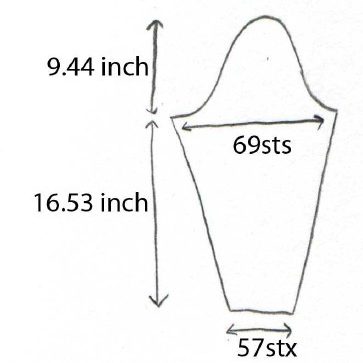
In the case of garments, very often diagrams of each piece are also included to show how big each side of the piece is and how many stitches wide it is at certain points.
This is an example from the Celtic Cabled Vest by Lusianne.
This drawing gives enough information, even if you are making a different size.
You can convert inches to centimetres, if you want.
You can calculate, using both her swatch and yours, how many stitches you need at both the cuff and widest part of the sleeve.
You can calculate, again using the swatches, how many rows you will need to get the length you require.
Diagrams and charts
Knitting charts are entirely different beasts.
Again, some people love them, others...not so much.
There are different types of knitting charts. You can have a chart for colour work. Even though you have to keep track of where you are, these can be quite simple. Each coloured square indicates where to knit the colour in question. The difficulty is entirely in the actual knitting, and not in the reading of the chart.
I have seen colour charts where colours are represented by symbols. That makes no sense to me. Using the actual colours is much more intuitive. If you decide to use different colours, you can easily replicate the pattern by creating a spreadsheet. Make all the cells square and colour them in. It really is as simple as that.
Again, if you can mark your progress while knitting, all the better.
Lace, cable and other stitch pattern charts are a different type to colour charts and can become quite complicated.
Often knit stitches are indicated by blank squares and purl stitches by black dots, but after that it becomes interesting. Have a look at these symbols:
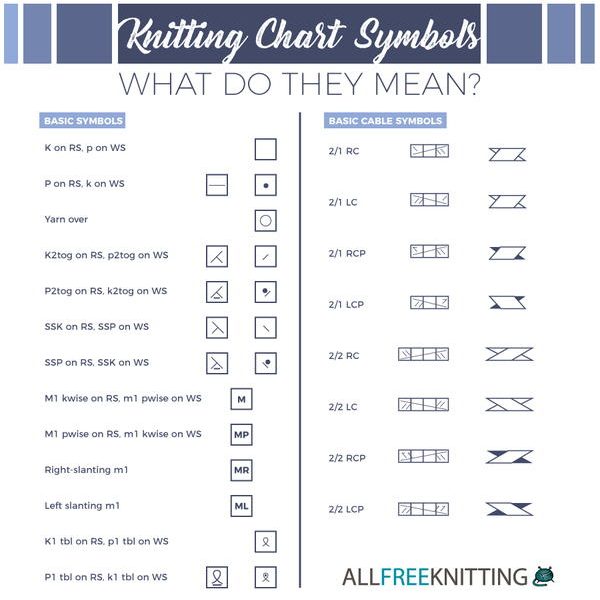
This list of symbols was taken from All Free Knitting
It does matter whether a chart is meant to be followed 'flat' or 'in the round'.
Remember, when you're using straight needles, you will work back and forth, so you will have to read the chart from right to left and then from left to right, and so on.
Additionally, some charts are written for 'flat' work, but only read in one direction. Or even numbered rows are left out entirely!
This is why reading the whole pattern is so important. You should make sure you understand what you're starting. If anything is not clear, you can usually contact the designer and ask for clarification.
I can understand if this article has actually increased your fear of patterns, but it doesn't have to be that way.
Try to approach a pattern like this:
- Check if the pattern has all the information you need.
- Read the entire pattern, making sure you understand the abbreviations.
- Check if you know every technique the pattern uses. If not, spend some time learning them before you start your project.
- Measure the person that will be wearing the garment, if possible.
- Get the materials and tools together.
- Make the swatch. Make changes to needles and yarn where required.
- If the pattern suggests you block the swatch, do it!
Now you're ready to start.
Yes, it's a bit of work, but your project will be all the better for it. And remember, you can always contact me if you need help with anything.
Happy knitting!
More articles to come.
Watch this space!